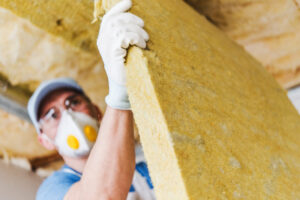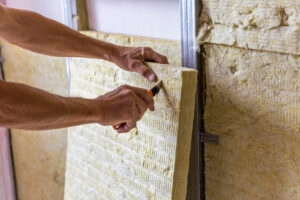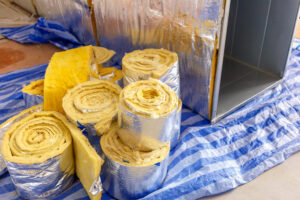
There are a bunch of different kinds of insulation that could be put in a house, and attic insulation is specifically the focus here.
Let’s learn about attic insulation.
Building Code and R-Value Requirements
Depending on what zone or region a home is in, building code requires a certain R-value. R value is how the amount of insulation is measured, the resistance to thermal heat or thermal transfer.
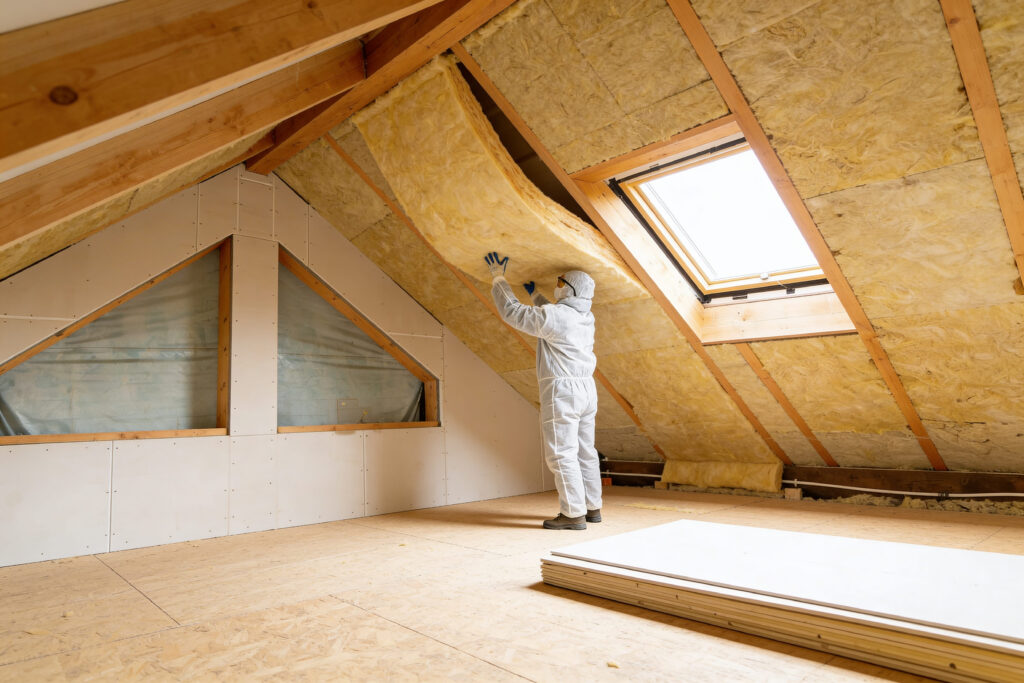
Attic Insulation in NJ
Depending on how much R value is present, that will determine how much heat gets transferred into the home from summer heat, how heat in the attic transfers down into the home, or how heat escapes in the wintertime from inside the home into the attic. That attic insulation slows, reduces, and lowers that transfer of heat. If insulation is compressed or compacted, it’s not going to be functioning properly at all.
Batt vs. Blown-In Insulation
There are different kinds of insulation seen in attics. Popping a head up in an attic will identify whether it’s batt insulation, the rolled-out sheets that usually fit in between trusses or joists. Most homes today are built with engineered trusses, and in between those there’s an open space where insulation gets rolled out.
Depending on whether trusses were made with 2x6s or 2x4s, that bottom cord is going to be 5 1/2 inches thick if it’s a 2×6, or 3 1/2 inches thick if it’s a 2×4. If rolled-in insulation just barely passes over that, there’s roughly 4 to 6 inches of insulation.
Measuring Insulation Depth Against Code
Building code today gets a home to the R49 or R60 level. R60 would be the maximum wanted; R49 is the minimum, though there’s a caveat that can bring requirements down to R30 depending on how the home was constructed. To get to R49 requires 16 1/2 inches of insulation.
Four, six, or eight inches is already substantially below where a home should be to be as energy efficient as possible. Up to building code, R60 is going to be almost 20 inches of insulation, almost two feet in the attic space, which sounds like a lot but isn’t that much money to reach that point, and the amount saved on energy bills is significant.
Energy Efficiency and HVAC Benefits
An HVAC system, heater, and air conditioning will be extremely efficient and run a substantial amount less with proper insulation, which will drastically prolong its life.
Replacing an air conditioning unit, furnace, or heat source is a major, very expensive undertaking, whereas insulation is very inexpensive, and savings on energy bills start instantly while prolonging the life of all of those systems.
Impact on Roof Longevity
A properly ventilated roof combined with proper insulation substantially prolongs the life of a roof. Attics with proper insulation and proper ventilation have been found with a 20-year shingle that hadn’t been replaced in 40 years and still looked great and functioned properly, because proper insulation and proper ventilation go hand in hand.
Cellulose vs. Fiberglass Blown-In Insulation
Blown-in insulation comes in a couple of different kinds. Cellulose is what a lot of insulation companies use because it’s very inexpensive to purchase; essentially, it’s recycled paper, ground up different paper products soaked in chemicals to make it more fire-retardant and mold-resistant, then blown in.
It’s extremely dusty, and little fibers get everywhere. Over time it will settle quite a bit, and the more it settles, the fewer air gaps there are, so the R value lowers as it continues degrading and settling. Cellulose that has settled down tends to be extremely messy with dust everywhere.
Why Proper Ventilation Matters
A properly ventilated roof with the proper amount of insulation makes a home more comfortable, reducing rooms that run hotter in summertime because heat won’t transfer down into that room, keeping cooler air in during summer.
In winter, insulation keeps heat inside the home so it won’t prematurely melt snow on the roof, which causes ice dams that destroy a roof faster than almost anything besides a tornado or hailstorm. Ice dams are an installment plan for destroying a roof over a few years, and proper insulation and ventilation prevent that entirely.
The Installation Process
Installing insulation in an attic is a fairly simple process. Tarps get laid down from the entrance of the home to the entrance of the attic space, and a long hose runs from the machine outside, blowing and separating the insulation through the tube while someone works in the attic.
At the entryway, a cardboard baffle gets installed to allow fill all around it, and batt insulation gets installed on the back of the attic hatch to reach the proper R value there too.
Cleanup takes place afterward, and the whole process should take less than one day for a good-sized attic, longer if baffles need to be installed.