It comes down to one question. Is your crawl space vented to the outside, or sealed up?
If it’s vented, with those little screened openings in the foundation, the insulation goes up in the floor joists, under the rooms you live in. If it’s sealed, or you’re about to seal it, the insulation moves to the crawl space walls, and the ground gets covered with a vapor barrier. The U.S. Department of Energy lays it out that same way. What you shouldn’t do is mix them up, like stuffing batts in the joists of a sealed crawl space, or insulating the walls of one that’s still pulling in outside air through open vents.
So let’s go through both, plus what New Jersey’s energy code actually asks for.
Floor joists vs crawl space walls
Crawl Space Insulation
| Insulate the floor | Insulate the walls | |
| Crawl space type | Vented | Sealed (unvented) |
| What’s inside the envelope | Only the rooms above | Rooms plus the crawl space |
| Ducts and pipes below | Left outside, exposed to outside air | Inside the conditioned space |
| Ground cover | Recommended | Required, sealed vapor retarder |
| Extra steps | Keep vents clear | Air sealing, and exhaust, supply air or dehumidification |
| NJ code R-value (Zone 4A) | R-19 | R-10 continuous or R-13 |
When does insulating the floor joists make sense?
When the crawl space stays vented. The Department of Energy’s advice is to insulate floors above unconditioned spaces, and a vented crawl space counts. You’re basically treating the crawl space as outdoors and putting the insulation line right under your floor.
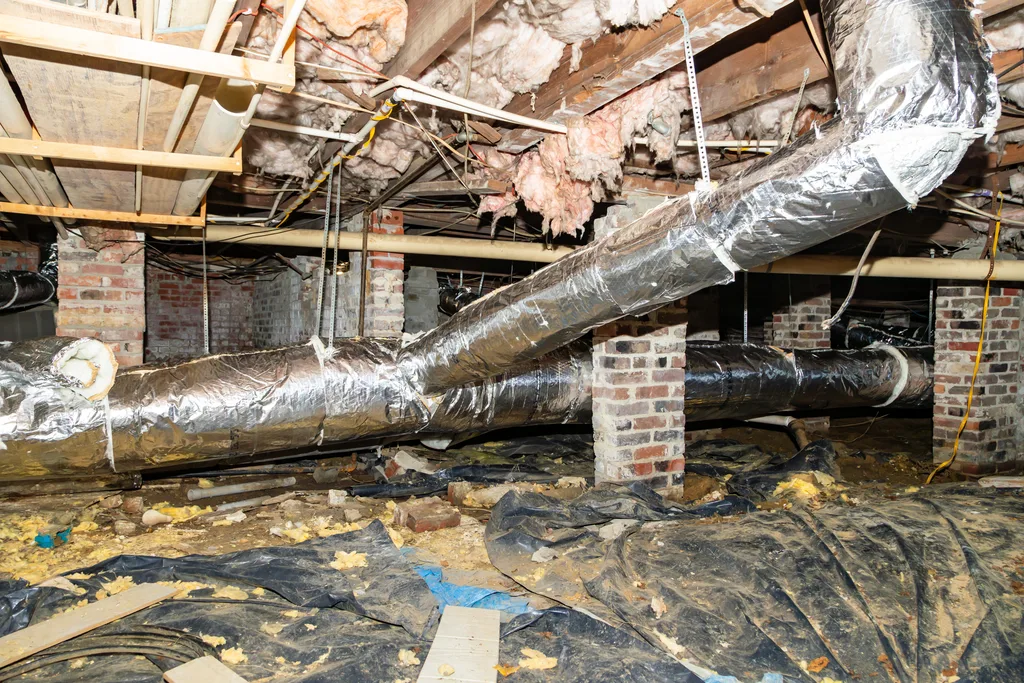
The catch is everything else down there. Got ductwork running through the crawl space? A water line? With floor insulation, those sit on the cold side, in air that comes straight from outside. In a New Jersey January, that’s a freeze risk for the pipes and wasted heat for the ducts, so both would need their own insulation.
Summer is the other problem. Penn State’s housing research center has a good example of why. Picture a sticky August afternoon. 86 degrees out, 77% humidity. That air slips in through the vents, and down in the crawl space it cools off to about 68. Cooler air can’t hold as much water, so the humidity climbs until it maxes out at 100%. Then it starts to condense. On the joists, on the ducts, on anything cool enough. And in a vented crawl space, that humid air keeps coming in all season long.
When should you insulate the crawl space walls instead?
When the crawl space is sealed, which is what encapsulation does. The vents get closed, the ground gets covered, and the crawl space becomes part of the house. DOE says that in this setup you seal and insulate the foundation walls rather than the floor. One upside it points out: any pipes and ductwork down there end up inside the conditioned part of the home, so they don’t need insulation for freeze protection or efficiency.
It’s not just closing the vents and walking away, though. The building code spells out what a sealed crawl space needs, under section R408.3 of the residential code:
- A Class I vapor retarder covering the ground, with seams overlapped 6 inches and sealed.
- The edges run at least 6 inches up the foundation wall and are attached there.
- One way to keep the air moving or dry: continuous exhaust at 1 cfm per 50 square feet, or conditioned supply air at the same rate. Current editions of the code also accept a dehumidifier.
Leave out that third one and the crawl space just sits there, sealed up and damp. Water’s the other thing. If it’s coming in through the walls or pooling after storms, deal with that before any insulation goes up. DOE points out that wall insulation down there can be ruined by water or by mice, and the whole space needs to stay airtight, or it doesn’t do its job.
This is the side of the job our Crawl Space / Basements work covers. We start by looking at what moisture is doing in there, clear it out, then put the liner down over the floor and up the walls and seal it. There’s more on the moisture side in Crawl Space Encapsulation: Moisture Control Benefits for NJ Homes.
How much insulation does New Jersey require?
Depends where you live. The state goes by the 2021 version of the national energy code for houses, and that code splits New Jersey into two climate zones by county.
Monmouth, Ocean and Middlesex are all in Zone 4A. That means R-19 if you’re insulating the floor, or for crawl space walls, either R-10 continuous insulation or R-13 cavity insulation.
Up north, it’s stricter. Bergen, Hunterdon, Morris, Passaic, Somerset, Sussex and Warren are Zone 5A, where floors call for R-30 and crawl space walls call for R-15 continuous, R-19 cavity, or R-13 cavity plus R-5 continuous.
Notice the wall numbers are lower than the floor numbers. That’s a big part of the appeal. Foundation walls are a smaller area to cover than the whole underside of the house, and the code asks for less R-value on them.
What material goes where?
On walls, foam is the usual pick, either rigid foam board or open and closed cell spray foam. Closed cell holds up to damp conditions well, which matters a lot below grade.
In floor joists, batt and blanket insulation is common, held tight against the subfloor so it doesn’t sag. Spray foam works here too.
And don’t forget the band where the floor framing sits on the foundation. Cold air sneaks in there either way. We wrote a whole post on it: Rim Joist Insulation in NJ: Why Cold Floors and Drafts Start at the Basement Edge.
Frequently asked questions
Should I insulate between the floor joists in my crawl space?
Yes, if the crawl space is vented. If it’s sealed, insulate the walls instead.
Can I insulate the crawl space walls and keep the vents open?
That defeats the purpose. Wall insulation goes with a sealed crawl space, a ground vapor barrier and some form of conditioning.
What R-value do I need for a crawl space in Monmouth or Ocean County?
R-19 in the floor, or R-10 continuous or R-13 cavity on the walls. Both counties are in Climate Zone 4A.
Does a sealed crawl space need a dehumidifier?
It needs one of three things under the code: continuous exhaust, conditioned supply air, or dehumidification.
Not sure which setup your crawl space has? DJG Insulation, led by founder Devin Gaydos, works across Monmouth, Ocean and Middlesex Counties from Wall Township (NJ HIC #13VH10534300). Call 732-226-5344, check our Residential Insulation services, see what’s eligible on our federal insulation tax credit page, or contact us.